
Most Businesses Don’t Have a Marketing Problem…
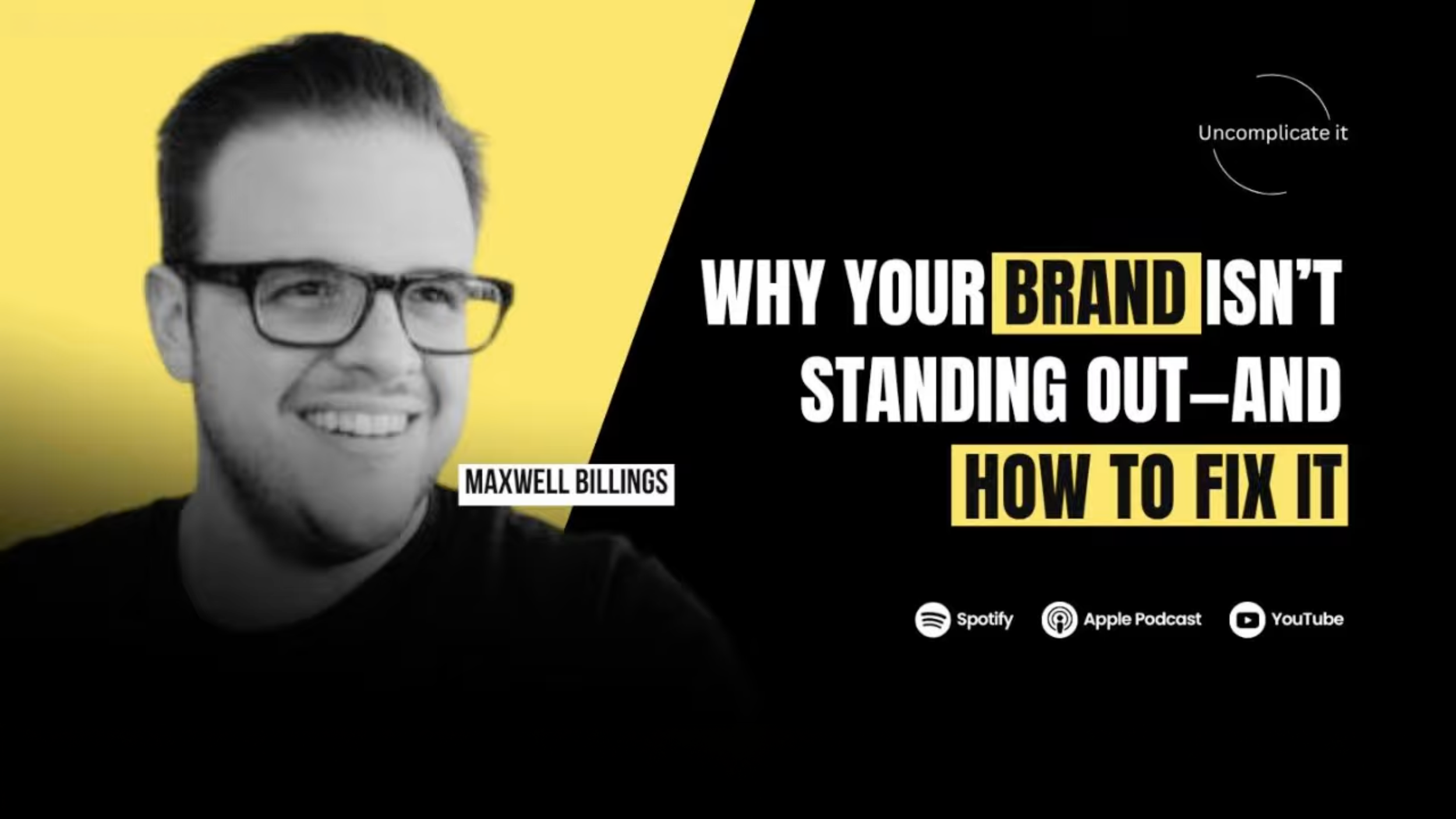
I sat down with Sacha Awwa on the Marketing Uncomplicated podcast to talk about something I say to founders almost every week.
Most businesses don't have a marketing problem. They have a clarity problem.
We covered the difference between a brand and branding, why founders never diagnose the brand as the issue, what I mean by brand therapy, why AI made everyone sound identical, and the one question that changes how a founder sees their own company.
The full conversation is above. Below is the transcript, lightly edited for length and readability.
Brand vs. branding: what's the difference?
Sacha Awwa: How do you define the difference between a brand and branding?
Maxwell Billings: This comes up more often than you would think, especially with founders.
Your brand is the feeling you have toward an organization. A company, a nonprofit, a group, whatever it is. Whatever that feeling is, that's your impression of the brand. It's personal to everybody.
Branding is the process of influencing that feeling and providing context to help inform it. The branding of Coca-Cola helps convey a certain brand feeling with its customers.
Starting there gives everyone a common language. Creatives, entrepreneurs, people who don't do this professionally. It lets all of us talk about the same thing at the same level.
What founders get wrong about branding
Sacha: What are founders usually getting wrong when they think about branding?
Maxwell: Where they really run into friction is a sense of disconnect.
A founder has their business. It's out there, it's running, they have their service. But something feels wrong. Maybe they're building a website, or launching into a new market. And there's a disconnect between what they're trying to convey out in the world and what's actually happening inside.
That's where branding comes in. Better understanding who you are, who you're for, and what you're about. That's the start of the self-awareness that builds a brand and shifts the story you're telling.
Who are you not for?
We've been working on a lot of projects in the CPG space recently. It's a conversation founders aren't used to having.
We all know we want to be for as many people as possible. We could talk about how that's a fool's errand. But the real question a founder needs to ask is: who are you not for? Who are you okay turning away?
That's where clarity really starts to kick in. That's how you figure out who you're actually for.
Make no small brands.
Sacha: You have a phrase, make no small brands. What does that actually mean?
Maxwell: It's taken from a Chicago architect at the turn of the century. Daniel Burnham. Make no little plans, they have no magic to stir men's blood.
The spirit of it is that thinking small isn't going to excite anybody.
If you're going to build a business, if you're going to invest the time, energy, and effort into creating something, make it big. It doesn't have to be a huge investment. Say something bold. Have a personality that differentiates you in the marketplace.
That's what people like about brands. It's not the ones that play it safe. It's the folks who have a personality and can push the narrative and challenge preconceived notions.
When we work with clients, that's one of the things we're always bringing up. How can you think bigger about what you're already doing? It's usually just putting extra effort into the things you're engaged in anyway.
Can a small business have a big brand?
Absolutely, and those are some of my favorite conversations.
That preconceived notion is one of the biggest things a founder can shake off. Even if you're a two-person restaurant, there are plenty of interesting things you can do with your menu and the social content you're creating.
A great example is Judy's Pancakes in Galesburg, Illinois. If you're on TikTok you may have seen her. She started creating content that drives her pancake diner business, and it blew up.
There's a silliness and a personality to it. She'll literally pop up in somebody's car and say, I'm Judy, try my pancakes. She worked with a producer in her town who makes social content and embraced the idea that it felt risky. She wasn't saying how amazing her pancakes were. It was silly. She didn't know what the ROI was.
It put her on the map. ABC News interviewed her.
Turn your constraints into scarcity
One of the biggest things small business owners need to lean into is the thing they think is a negative. Your size.
We can only produce 200 units a quarter.
Well, now you have a limited edition. Now you have number one of 200. Now you have scarcity. That's something you can lean into as a positive.
It's not, we can't make enough. It's, we can't make enough, we're trying as much as we can, and when we're sold out, we're sold out.
Same facts. Completely different sentence.
There's no benefit to playing it safe. That's not to say be reckless. But if you're small and starting out, the ability to make big, bold moves at your size is one of your advantages.
What is brand therapy?
Sacha: You describe what you do as brand therapy. That's not something you hear from most agencies. Where did that come from?
Maxwell: It started with my origin story. In the world of agencies there was a broad disconnect between the founders leading the charge and the people actually executing. A lot of it came down to personal hang-ups, or not giving the time and space to actually think about the problem.
For a lot of founders and entrepreneurs there's enormous personal investment tied up in the brand. It's their great big idea. It's quite literally their baby. Their DNA gets passed into the brand and the business.
So a big part of what we do is helping people detach that. So it isn't a customer attacking you. It's another entity with values, personality, vibes, and vision that isn't directly the founder.
Reducing decision fatigue
We're not only helping the founder remove preconceived notions and translate their personality into something people can follow. We're also creating a decision-making system.
It reduces decision fatigue. Here's how the brand should act, so your team can activate and bring things to life inside that playbook without you managing everything.
It's a triple threat. Pulling things off your plate, making decisions easier, and inviting more people into the question of what the big vision actually is.
Inviting the whole team in
I'm your CFO and I never get invited to marketing meetings, but here's a way we could deliver on what you're talking about.
And it's like, oh my gosh, that idea just came from someone completely new.
Folks love to laser in on the website not working, or the ROI on marketing. But time out. It starts with the team and the people and the founder. What's the hangup here?
I'm willing to bet it's not some magic combination of three words. I'm willing to bet it's the four years of friction you've been feeling, unable to tackle this one problem, and it's the first time you're able to talk about it.
That's where the therapy comes in. Giving space to talk about big brand and business decisions in a place where nobody's going to yell at you and nothing is a dumb idea.
Why founders don't see the brand as the problem
Sacha: You say most founders never see their brand as the problem, but they feel it. What does that look like when somebody walks through your door?
Maxwell: Usually they're three or four conversations into some other initiative. Let's rebuild our website. Let's go into this new market. Let's do something new.
Great. Good. We're looking to add an extension onto the house. Excellent.
Oh no, there's a problem with the foundation.
We don't have to fix it now, but there's a big crack somewhere and we have to fix it.
So it's a packaging initiative, a website, a new market. And suddenly there's this feeling of friction. This doesn't fit. Why doesn't this look good? Why doesn't this feel like us?
That's the first sign that you've changed. It's like putting on your wardrobe from when you were eight years old. The bottoms of your pants are hitting your knees. You've grown. Those clothes don't fit anymore.
The symptoms founders describe
People come into the world of branding not realizing branding is what they need. But they're spotting the diagnostic triggers:
We don't sound specific enough
We don't have a creative edge
We look like our competitors
How do we be bold without going out of bounds
Those are the big questions a fully thought-through brand can start to answer.
Marketing problem or positioning problem?
Sacha: Do you find they attribute it to a marketing problem rather than a positioning problem?
Maxwell: Yes, because marketing is the easy solve. We're investing in this channel, this channel is responsible for driving sales, and it's not doing well.
A lot of times people come into the conversation self-diagnosing. It's a bit like, I was on WebMD and here's what it says I'm sick with. And it's, okay, I can see you didn't lose your left leg. You rolled your ankle.
But there's usually a real humility and self-awareness there too. We know things are wrong. We need to fix something. We don't necessarily know how.
Your customers are already telling you
Maxwell: In our workshops we create space for teams to share what customers are saying. A lot of times the founder will say, oh, that's interesting, when did that conversation happen? A couple of months ago. Oh. Okay.
It creates a two-way dialogue. Founders are naturally detached from the everyday interactions.
We were working with a home security client and their head of UX sat through most of the session without saying much. Then she chimed in with a wonderful insight about their customer and one of the main friction points in the business. That would never have organically come up on its own. But we created the territory and space to talk about the brand.
You don't need six months of focus groups. Odds are you've gotten an email recently with good feedback. Listen to it. Your customers are telling you. It's up to you to dissect and analyze it a little.
That's how you create the information loop. Where should we invest our energy? Well, people say they're having problems with the purchasing platform. Okay. There's your answer.
The Sonos lesson
Sonos became detached from what was really their core audience.
Everyone has that grand desire to be for everybody. If you have an infinite budget and infinite time, that sounds accomplishable. For the rest of us, we have to dial in and pick a target customer.
One of the things I like to impart on people: let your product or service be for everybody, but focus your marketing and messaging into a very targeted segment.
Everyone loves music. Great. But Sonos took their eye off the ball. It was the power users using key features. That's where friction gets created, and that's how you lose the confidence of your key audience.
Working across industries
Sacha: You work across CPG, hospitality, tech, professional services. How do you move between those worlds so effectively?
Maxwell: I have a background in advertising and agencies. That environment was frantic. You'd be working on Citibank, then they need you for 72 hours on a new business pitch, then you're on Craftsman, then Mike's Hard Lemonade needs something.
You learn to quickly shift your thinking and immerse yourself in a world. That's where I understood that superpower about myself. Being able to nerd out, lock in, and build out a world.
So one of the things I established early, and it's worked ever since, is building systems. What we're doing has a formula to it. There's a methodical, logical process.
That's what clients are interested in. They don't want a wildcard. They don't want, I don't know, I just jump in for three months and it happens. They want to know your game plan.
Our process is called BrandFusion. It lets us immerse ourselves in the client, the people, and where things are going. And we use a system to develop the visuals so people with no design background can understand it. Here's this big bold idea I had, and here's how close it can possibly be to being real.
That removes the mystery. And that's the throughline between verticals and between B2B and B2C. Empathizing with people is the commonality across every project.
Cross-industry pattern transfer
You could be having a jewelry conversation in the morning, a nonprofit education conversation in the afternoon, and then talking about croissants half an hour later because a bakery client popped up.
One of the real advantages is being able to expose founders to what other people are doing. Hey, coffee client, here's a packaging solution we learned from a beauty client that you never would have encountered otherwise.
A coffee client isn't having conversations with a web developer building an iPad game, or the newest SaaS startup. Being that conduit is one of the most interesting parts of the work.
Rigid in approach, flexible in the outcome
We have our workshop and our structure. But a lot of times I'll start those meetings by just saying, talk to me. What's going on? What's keeping you up at night?
And a lot of times, there's the priority. We don't need a formal exercise to find it.
Partner vs. vendor
Sacha: A lot of companies say they work with founders as partners. But it's not really their DNA. How do you make that real?
Maxwell: Being genuine helps. I'm a Midwesterner from Chicago, so I'm a friendly guy no matter what. Golden retriever energy.
But it's mostly about being genuinely interested in what these people are trying to do. A lot of these entrepreneurs have a big, engaging story. That's a big part of why we're there. I want to hear what you have to say. It doesn't have the pressure of a Shark Tank. We want it to be disarming.
And when it comes to being a partner, the thing a lot of people miss is that it also means saying no.
If you're working with someone and they say yes to whatever you want all the time, that's a vendor with no boundaries. A partner pushes back.
That's something I've had to learn. Midwestern people pleaser. But it matters.
Going back to my origin story, I've spent a lot of time sitting in rooms where executives say, okay, great, how are we going to do that? I don't know, but it's on us to figure it out. And it's like, can we pause and have a candid conversation about why what you just said runs counter to the statement you made thirty seconds ago?
I've called that out in meetings. With one of our recent clients, on our very first call, he was describing the customer group they were going for and how they were driving impact. And I said, look, you're going to talk to a lot of different people trying to figure out if it's the right fit. Here's why I think you need to push what you just said.
I gave him three genuine reactions. I wasn't trying to win the business. I said, I want you to do well. Here's my honest take. If you like what I have to say, let's keep working together. Otherwise, all good.
Not forcing it is a big part of finding a genuine connection with people you like working with.
What predicts whether a brand project works
Sacha: What's the through line between the founders who break through and the ones who don't?
Maxwell: It's self-awareness. And it comes down to the level of self-investment.
Obviously there are real-world circumstances. Time, finances, whatever it might be. But especially with solopreneurs, I call it out directly. This is an investment in you and what you're doing. You're doing this because you believe it's worth more than this initial engagement.
It's like holding up a mirror. I need you to look at it. And it's, okay, yes, I am worthy to be invested in. This is something I can do. This is a big idea I have. I do believe people want this thing. And yeah, it may fail, but I'm going to learn something about myself in the process, and it may be the next thing.
I can tell very quickly. I'm the son of a serial entrepreneur, and that attitude is infectious. I don't know, I'll figure it out. That's a thousand percent the right attitude.
The folks who struggle are the ones who feel small and are trying to break out of being small and can't get out of their own way.
What's missing is the humility to say, there are things I don't know. Who should I listen to? Maybe an expert where this is all they know. Even the best athletes need a coach. Someone to say, you're doing that wrong. I can't do that, but I can tell you how.
When founders get in their own way
I worked with a client in England doing $15 million annually who wanted to see every Twitter post that went out. That company could have been at $30 million if he had stepped away from the nitty-gritty and actually done his job as CEO.
The cost of a CEO checking a tweet makes it the most expensive tweet that company has ever created.
Founders bring people on to help make decisions, then keep making the decisions themselves. And underlying it is fear. If I make this decision, we're not going to grow. We're not going to hit the goals.
One of the transformative books for me was Buy Back Your Time. It shifted how I think about where my time and energy go.
And here's the reframe. For as much time as people spend overthinking how it can go wrong, you should probably spend equal time overthinking how it could go right. What if that new hire crushes it? What if they solve the problem faster than you anticipated? What else can they do?
AI, sameness, and why human-made work is coming back
Sacha: We're living in a world of AI generated content and templated brands. Everyone's starting to sound alike. How do you handle a founder who says AI can do this in six seconds?
Maxwell: There's a post I saw that sticks with me whenever this comes up. AI requires clients to describe exactly what they want.
And it always agrees with you.
Which goes right back to being a good partner. You've got to be able to say no.
Everybody is using the same tools. So now everyone looks and sounds the same. And that goes right back to the things that make you unique. The things that make you weird. Your story. Your personality. The things no AI system could come close to capturing are all part of what differentiates you in the marketplace.
We've lost projects where founders decided to build it in ChatGPT instead of engaging us. What they quickly realize is they're right back where they started. They spent all this time, energy, and credits creating stuff, but they don't know how to use it. They don't know why it matters. They don't feel connected to it.
It's just more noise on top of uncertainty.
Making the stuff isn't the magic. Going through it is. The hard part of a marathon is training for the marathon.
I'll be honest, at least once a week I have a client say, I asked ChatGPT and it said this, but I don't trust it. What do you think?
The pendulum is swinging back
We're starting to see it swing back. My background is in fine art, drawing, illustration, photography. Clients are embracing and wanting human-made assets because it says we're working with people. We're not photocopying and sending stuff out.
You've probably seen the bar down the street make an AI flyer for their food special and thought, that just seems cheap. Why are you guys doing that?
It's all going to start looking the same. Just like all these websites are starting to look the same. And then what's special about this? Why would I go there? You're showing me something that's fake. I want something that's real.
Rebellion and the underdog brand
Sacha: You talk about founders being rebellious, and how that makes a brand irresistible. Tell me about that.
Maxwell: A big part of brand building, and especially personal brand building, is finding the things you relate to that make you feel special.
The name of my studio is EightySeven. That was my birth year. A big part of what we do is helping founders get back to what got them excited. What were you born to do? What gets you jazzed up?
I have a whole Star Wars nerdery and I absolutely love it. You love rooting for the underdog. You want to support that group of rebels doing something a little different, maybe a little dangerous, a little outside the bounds, going up against the big system.
With startup brands, a lot of times they are defecting from the big organization because something wasn't right. We could have done this a better way, and here's what I think we can do. Let's start our own little commercial rebellion.
That spirit is the infectious sign of people who are driven to build something. Not people who want to set something up, get bought out, and retire.
That's where the storytelling comes from. They were in a situation so near and dear to their heart that they had that reaction. Something's got to change and I'm going to be the one to change it.
Sharing the things you thought were vulnerabilities actually invites people in. Oh, you're not perfect, and that's what I love about you. The parts of your personality that are weird or different or quirky, that's what people like.
And then all of a sudden you have a small group of chaotic rebels around you. There's your community. There are the people who will hype you up and give you momentum when things are slow.
The question every founder should start with
Sacha: If somebody is looking at their brand right now, what should they be asking themselves?
Maxwell: The value they provide to people.
That gets every founder out of their own mindset and motivation and puts them in the shoes of the customer. It's a forced empathy shift right away.
And that's the start of really understanding. Here are all these things we thought were important, but our customer actually cares most about number five on the list. And that surprised us.
We're working with a client right now where exactly that happened. We had a decent idea of our lineup of key features. Then we introduced it to customers and had open conversations, and a feature that was relatively low on the list started creeping up. And you get that feeling of, maybe we should reassess what we're truly providing.
Regardless of industry, you're going to have competitors. They're all making the same widget, the same croissant, the same coffee. You all have your individual spin.
The real question is what value can you uniquely provide to that person.
That's the start of differentiating, empathizing, and thinking about the business in a different way.
Rapid fire
One word that defines how you approach branding and life.
Empathy. Being able to relate to where others are coming from, and trying to understand. I think that's a big lacking thing in how we interact with one another right now.
One myth about branding you wish people would stop believing.
That they're not creative.
I hear it constantly. Oh, I just deal with spreadsheets. To which I will aggressively say, but have you ever had to solve a problem? Well, yes. Then you're creative. That's all creativity is. Problem solving under a different lens, in a different medium.
One habit that's had the biggest impact on your success.
Making it a habit to be authentically you.
We're all going through various phases, personally, professionally, emotionally. But finding what kind of person you are and what really lights you up is one of the big things. Whether it's in business with your brand, or just personally. Being authentic and caring about what you're doing, the work you're making, and the people you're working with.
That's all you need to do. Everything else takes care of itself. That's what I tell myself when things get slow.
FAQ
What is the difference between a brand and branding?
Your brand is the feeling someone has toward an organization. Branding is the process of influencing that feeling and providing context to shape it. The brand lives in the customer's head. Branding is the work you do to inform it.
Is my problem a marketing problem or a positioning problem?
Marketing is usually the first thing blamed because it's a line item with numbers attached. But if your team is saying things like we don't sound specific enough, or we look like our competitors, that's positioning. Marketing is where the symptom shows up, not where it starts.
What is brand therapy?
It's the process of separating the founder's personal identity from the brand so the brand can operate as its own entity, with its own values and personality. It reduces decision fatigue for the team, takes work off the founder's plate, and creates space for people across the company to contribute to the brand.
Can a small business build a big brand?
Yes. Personality costs almost nothing. Small companies often have advantages larger ones don't, including the ability to make bold moves quickly and to turn production constraints into scarcity and limited editions.
How do you differentiate when everyone is using the same AI tools?
By using what AI can't access. Your story, your point of view, the specific reason you started the business, and the parts of your personality that don't fit a template. When everyone is prompting the same models, sameness becomes the default and originality becomes the differentiator.
Who should a brand not be for?
Every brand should be able to name who it's willing to turn away. Naming who you're not for is what makes the message specific enough to move the people you are for. A useful rule: let the product be for everybody, but point the marketing at a narrow, specific segment.
Want to find out where your own brand stands? Take the Brand Clarity Score.
